Alright, let me cut to the chase—if you’ve only had “meatballs” before, you’re sleeping on the Yangzhou-style Lion’s Head. I’ve been running my family’s small batch, traditional Lion’s Head supplier for over a decade, and let me tell you, most places don’t get what makes these things actually special. It’s not just about the meat. It’s about every tiny, specific choice we make from the mince size to the braise time, and that’s exactly what I wanna break down for you today. Lion’s Head Meatballs
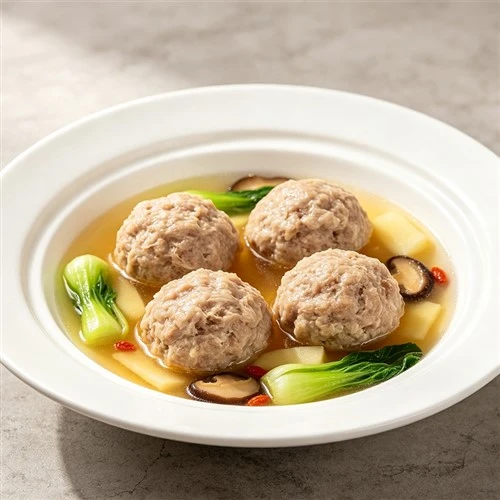
First off, let’s get one thing straight: these aren’t your average Italian-American meatballs you grab from the frozen section. For starters, the cut of meat matters. We only use a mix of pork belly and pork shoulder, right? Most suppliers will skimp and use pre-ground generic pork to save a buck. But not here (or anywhere that’s actually making proper Yangzhou Lion’s Heads). The ratio is non-negotiable—60% belly, 40% shoulder. The belly gives that rich, melt-in-your-mouth fat, and the shoulder has enough lean to keep the ball from falling apart when you simmer it. If you get too much lean, it gets dry and rubbery; too much fat, it’s just a greasy mess. I’ve seen so many places blow this ratio, and their Lion’s Heads taste like lumpy fat patties.
Then there’s the mince size. Wait, I know, you’re thinking “what’s the big deal? It’s just ground meat.” But trust me, it is. We don’t use a meat grinder. Hand-chopping only. Not because grinders are bad, but because grinding shreds the meat fibers too fine. Hand-chopping keeps them a little longer, a little coarser—like, pea-sized chunks, not paste. That texture is everything. When you bite into one, you get little bursts of fat and meat, not a uniform mush. I’ve had customers tell me they used to think Lion’s Heads were boring until they tried ours and realized how different the chew is. That’s the first big unique thing most people miss: the hand-chopped, specific cut ratio, not generic pre-ground pork.
Next up, the shape—well, sort of. Wait, no, it’s not just round. Yangzhou Lion’s Heads are supposed to be big, like, palm-sized. Because you’re supposed to eat one per person, not a handful of small balls. And the “head” part? Oh right, the name comes from the way the fat chunks peek out when you simmer them, like a lion’s mane. But here’s the thing about shaping: you have to handle the meat super gently. If you squish it too hard when forming the ball, all the air gets squeezed out, and when you braise it, it gets dense and tough. We roll each ball in our hands just enough to hold its shape, no forcing. I can’t tell you how many times a new trainee has over-worked the meat and ruined a batch early on. Patience, y’all. That’s a small step but it makes all the difference.
Now the braising part—this is where the magic really happens, and where 90% of commercial versions go wrong. First, we don’t just toss the meatballs in a pot with water and soy sauce. The Yangzhou style has two main braise methods, right? Red braise and white braise. Red is the most common, uses light soy, a little dark soy for color, rock sugar for sweetness, and then aromatics—ginger, scallion, maybe a few dried shiitakes. But here’s the secret: we line the bottom of the pot with napa cabbage first. Not on top, on the bottom. Why? Because the cabbage acts as a barrier so the meatballs don’t stick to the pot and fall apart, and also the cabbage absorbs all that savory, sweet braising liquid, making it even more flavorful. Most places put the cabbage on top as a garnish, which is lazy and wasted. We layer the meatballs on top of the cabbage, then cover, and simmer on low heat for an hour and a half. No high heat, no boiling. Boiling makes the meat seize up and get tough. Slow, gentle simmer is non-negotiable.
Wait, also—additions. A lot of recipes add breadcrumbs or eggs to bind the meat. But we don’t. At all. The fat and the meat fibers themselves hold the ball together. No fillers, no binders. That’s why the hand-chopping is so important—those long fibers stick together. If you use a binder, it’s like masking the actual flavor of the pork. You want to taste the meat, the braise, not some weird filler. I’ve had suppliers ask me why I don’t cut corners with breadcrumbs, and I just tell them: if a customer wants filler, they can buy their frozen meatballs at the grocery store. We don’t do that here.
Then there’s the side, right? Proper Yangzhou Lion’s Heads are served with the braising cabbage, maybe a little scoop of rice on the side. The liquid is supposed to be thick, glossy, not watery. We reduce the braising liquid a little at the end to get that shine, and we don’t over-salt it. The rock sugar balances the salt from the soy, so it’s savory and a little sweet, not just salty like a lot of cheap versions.
I know what some of you are thinking: “This all sounds good, but is it actually unique?” Yeah, because almost no one does this the traditional way anymore. Most mass-produced Lion’s Heads use pre-ground meat, grind it too fine, use binders, simmer on high heat for way too short a time, and skip the cabbage barrier. They’re just “meatballs with a Chinese name” and none of the heart of the dish.
For us, every batch is small—we only make 50 to 60 balls a day, max. No big industrial runs, because if we did, we’d have to cut corners. My dad started this back in 1998, and he taught me everything—hand-chopping the meat, lining the pot with cabbage, that slow simmer. He’d always say “a Lion’s Head isn’t just food, it’s something you take pride in making.” And that’s stuck with me.
Another thing I love about these: they’re versatile. You can heat them up in the microwave for a quick dinner, or reheat them for a dinner party and everyone thinks you’re a master chef. But even when they’re simple, like just a ball and some rice, you get that depth of flavor from the braise that you don’t get from any other meatball. I’ve had regulars tell me they come back every week because their kids request it, or they serve it at family gatherings and everyone asks where it’s from.
Wait, let’s talk about the science of it a little, because I get that some of you care about why things work. The hand-chopped meat: when you grind meat, the muscle proteins (actin and myosin) get torn apart more, which means when you cook it, they cross-link more and get tighter, drier. Hand-chopping keeps the protein strands more intact, so they stay tender and juicy. Then the slow simmer: at low heat, the fat in the belly melts slowly, so it doesn’t render out all at once, which keeps the ball moist. If you boil it, the fat shoots out, leaving the meat tough. And the cabbage barrier: cabbage has pectin, which breaks down slowly and creates a smooth layer between the pot and the meat, so no sticking. That’s not just a trick—it’s chemistry that makes the ball hold its shape.
I also think the cultural context plays a part in what makes them unique. Yangzhou is in Jiangsu province, right? It’s a city that’s super into food, part of the “Eight Great Cuisines” of China. Lion’s Heads have been around for centuries—some say they date back to the Sui Dynasty, when the emperor visited Yangzhou and local chefs made these big meatballs to impress him. The name “Lion’s Head” comes from the way the meatballs look with the fat chunks, but also maybe a play on words in Chinese. The point is, it’s not a random meatball creation—it’s a dish with a long history, where every step was refined over generations, not just made up to sell food fast.
But here’s the thing: I don’t ramble about this to be snobby. I ramble about it because I’ve seen too many people settle for garbage versions of this amazing dish. Last month, a restaurant owner came to me, said he’d been serving Lion’s Heads that his supplier made, and his customers were complaining they were “dry and boring.” He tried ours, and called me a week later to say his whole menu changed because of it. That’s the stuff that keeps me going.
Now, if you’re a restaurant owner looking to add a signature dish, or a caterer needing something that’ll stand out, or even a grocery store that wants to carry authentic, high-quality Lion’s Heads instead of the frozen junk—let’s talk. We work with small to mid-sized businesses that care about real food, not just profit. We can do bulk orders, fresh or even frozen (but trust me, fresh is way better—we flash freeze them right after braising to lock in that flavor), and we’re flexible with quantities, no minimums that make no sense.
Wait, one last thing to make sure you don’t miss: when you order our Lion’s Heads, you’re not just getting meatballs. You’re getting a dish that’s made with the same care as it was 200 years ago, just scaled for modern kitchens without losing the soul. No shortcuts, no weird additives, just good pork, good aromatics, and time.
So if you’re tired of the same old meatballs, if you want something that’s actually unique and tastes like it was made by people who care, hit me up. Let’s chat about how we can work together. No pressure, no weird hoops to jump through—just good food and good business.
Braised Beef References:
- Anderson, E.N. The Food of China. Yale University Press, 1988.
- Chang, K.C. Food in Chinese Culture: Anthropological and Historical Perspectives. Yale University Press, 1977.
- Yangzhou Cuisine Association. Traditional Dishes of Yangzhou: Lion’s Head Meatballs. Jiangsu Science and Technology Press, 2012.
- McGee, Harold. On Food and Cooking: The Science and Lore of the Kitchen. Scribner, 2004.
Yangzhou Jingsheng Food Co., Ltd.
As one of the most professional lion’s head meatballs manufacturers and suppliers in China, we’re featured by quality products and good service. Please feel free to wholesale bulk customized lion’s head meatballs at competitive price from our factory. Welcome to contact us for quotation and free sample.
Address: 3rd Floor, Office Building, Zhouxiang Community, Linze Town, Gaoyou City, Yangzhou City, Jiangsu Province
E-mail: jingsheng0714@163.com
WebSite: https://www.jingshengfood.com/
